

Welcome to part 2 of my blog series in which we discuss the ‘ideal lips’. In the first part, I covered various lip trends throughout the decades to show that trends come and go, but that we must always be cautious about blindly adopting trends, as not every trend suits our face. Science uses various mathematical lines and proportions, as well as the golden ratio, to determine the ideal lips. I often use these as an aesthetic physician, although I use them more as a reference than as an absolute (!). Additionally, I take into account the individual face of the patient, as well as personal preferences. The most important thing is that YOU are happy with your lips, since you have to walk around with them every day.
VIDEO:
If you would like to book a consultation and/or treatment for lip fillers, you can do so via this link. Also, take a look at the Doctor Contour Clinic website!
Please note: The following text and video provide a brief overview of what constitutes attractive lips according to science. There are many more important elements. Please contact a lip filler expert to create your ideal lips!
This video and blog post are for informational purposes only and cannot replace a personalized consultation with a qualified doctor.
How Knowledge of Attractive Lips Can Avoid Unnatural Results Such as ‘Fish Lips’ and ‘Duck Lips’
In addition to volume, there are several other crucial elements that contribute to the beauty of lips. Shape, contour, proportion, and projection all play an essential role in creating an attractive mouth.
You may be familiar with the infamous ‘fish lips,’ where the volume is distributed almost equally between the center and the edges of the lips, or lips that protrude too far in profile, similar to a duck. These types of results often indicate lip augmentations that are not in line with scientific insights into what truly makes lips beautiful.

2. The Rule of Thirds
The Rule of Thirds, emphasized by Leonardo Da Vinci, divides the face into three equal parts for aesthetic harmony. In the lower third, the distance from the nose to the lips should be one third, and from the lips to the chin two thirds, for balanced facial proportions.

3. Golden Ratio
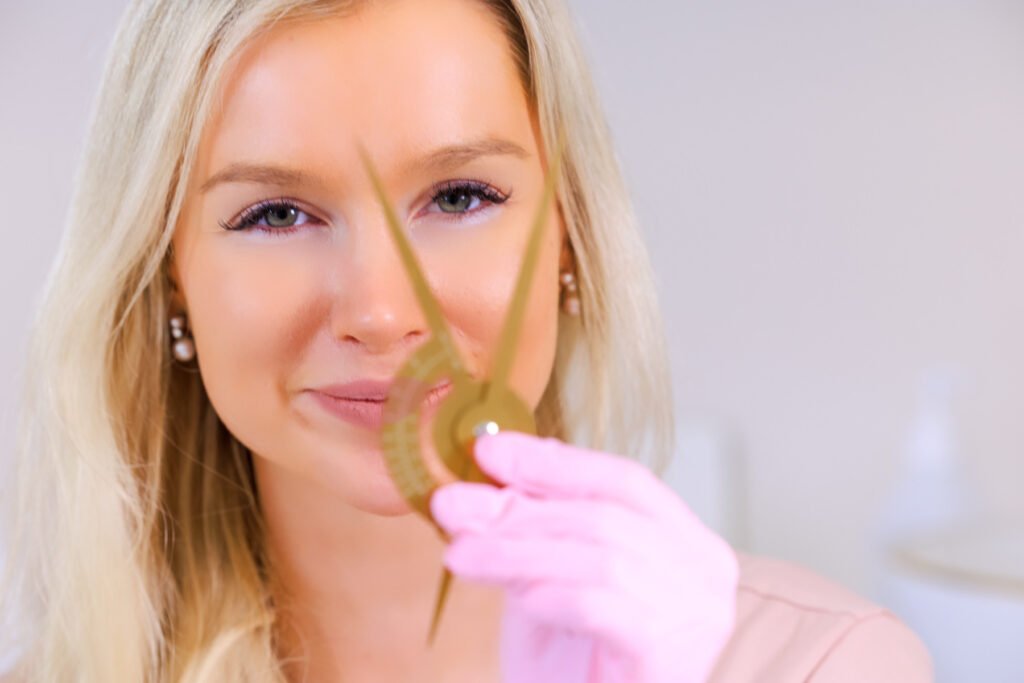
As an aesthetic physician, I always use the golden ratio as a reference for beauty. The golden ratio is also important in determining the ideal lips: from the ratio between the upper and lower lips to the width of the mouth, to where the most volume in the lips should be located to avoid the typical ‘fish look’.
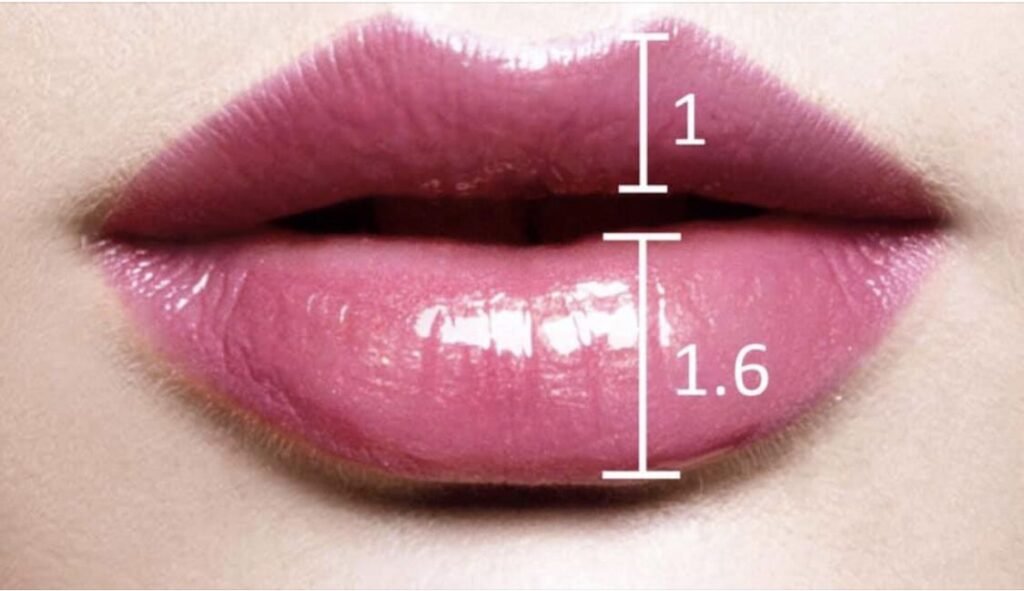
4. Proportion between Upper and Lower Lips: Golden Ratio or 1:1 Ratio?
The proportions between the upper and lower lips vary by ethnicity and thus influence facial aesthetics. Among people of European descent, the golden ratio often prevails, where the upper lip is slightly smaller than the lower lip. In contrast, African, Latin American, and Asian populations usually prefer a 1:1 ratio, sometimes with a slightly fuller upper lip.
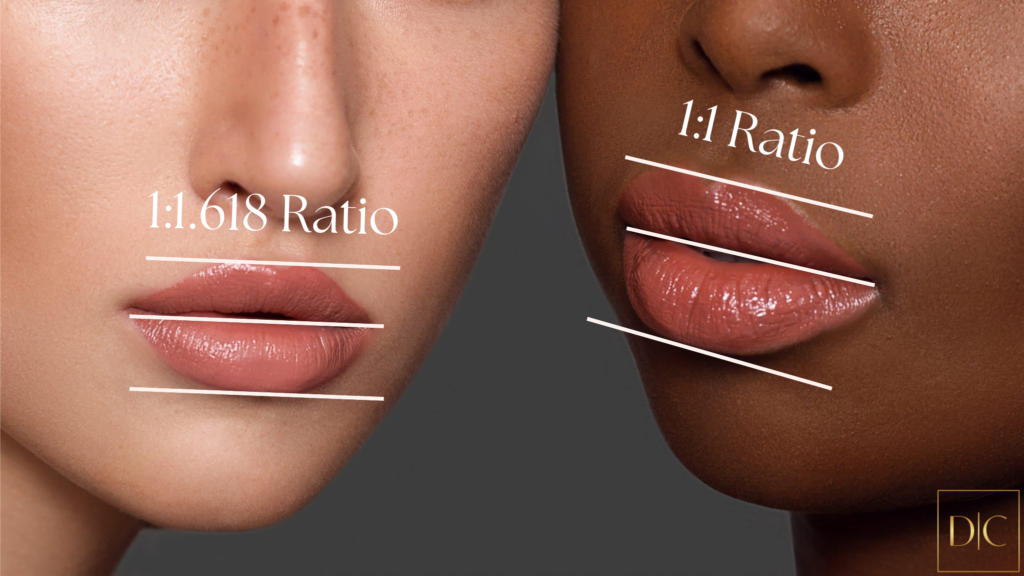
Recent global trends, amplified by social media, show a significant preference for this balance, deviating from the traditional golden ratio, and underscore the dynamic nature of beauty standards.
5. Voorkeuren in Lipvolume Verschillen Naargelang Etniciteit
In addition, we observe a striking difference in preference for lip volume between different ethnicities.
Asians prefer smaller lips compared to people of European descent, while Latin Americans prefer larger lips. Africans naturally have fuller lips, both when viewed from the front and in profile, and also have a preference for fuller lips.
6. Lips Seen from the Side
We must view lips from multiple perspectives; not only from the front, but the side view is also crucial.
A good aesthetic physician uses the Ricketts line or E-line, where a line is drawn from the tip of the nose to the chin. The rule is that the lips must not cross this line to maintain a natural appearance and avoid the notorious ‘duck lips’.

These ‘duck lips’ often occur when the treating physician has insufficient knowledge of aesthetic principles such as the Ricketts line. Although there are differences between ethnicities, the general rule is that the upper lip ideally overlaps the lower lip by approximately 2 mm.
Additionally, it is necessary to check whether the nose and chin are in balance with the lips. Sometimes it may be necessary to use fillers here to achieve a harmonious result.
Conclusion
After reviewing all the lip trends of the past decades, along with this concise overview of what science says about ideal lips, I want to conclude with a summary of what attractive lips are today.
Are these the lips of Clara Bow in the 1920s with the strongly pronounced cupid’s bow, or the voluminous lips of Angelina Jolie, or the lips of Kylie Jenner?
Ideal lips are primarily those lips that are in perfect harmony and balance with your specific face, taking into account your ethnicity, face shape, and general facial features.
Kylie Jenner’s lips, for example, would not suit a long, narrow face, and while Angelina Jolie’s lips suit her well due to her rather strong jawline, they would not suit another face.

If you are considering lip fillers, it is especially important to choose a good doctor who is knowledgeable about what makes lips look beautiful and what will also suit your face (and not to forget, a doctor who has received training in lips so that the procedure is carried out safely!).
If you would like to book a consultation or treatment with me as your doctor, you can do so via the Doctor Contour Clinic online booking form.
If you are considering lip augmentation using fillers, you have come to the right place at Doctor Contour Clinic. We do not believe in a ‘one size fits all’ approach, but strive for a personalized approach in which we take into account your entire face and appearance to give you the most beautiful lips that suit you.
Book your consultation or treatment now!
Scientific sources
- Heidekrueger PI, Juran S, Szpalski C, Larcher L, Ng R, Broer PN. The current preferred female lip ratio. J Craniomaxillofac Surg. 2017 May;45(5):655-660. doi: 10.1016/j.jcms.2017.01.038. Epub 2017 Feb 12.
- Heidekrueger PI, Szpalski C, Weichman K, Juran S, Ng R, Claussen C, Ninkovic M, Broer PN. Lip Attractiveness: A Cross-Cultural Analysis. Aesthet Surg J. 2017 Jul 1;37(7):828-836. doi: 10.1093/asj/sjw168.
- Baudouin JY, Tiberghien G. Symmetry, averageness, and feature size in the facial attractiveness of women. Acta Psychol (Amst). 2004 Nov;117(3):313-32. doi: 10.1016/j.actpsy.2004.07.002.
- Kar M, Muluk NB, Bafaqeeh SA, Cingi C. Is it possible to define the ideal lips? Acta Otorhinolaryngol Ital. 2018 Feb;38(1):67-72.
- Ding, A. (2021). The Ideal Lips: Lessons Learnt from the Literature. Aesthetic Plastic Surgery. doi:10.1007/s00266-021-02190-x